
Apple surpasses $4 trillion in market value for the first time, marking a historic milestone. Alongside Microsoft and Nvidia, the “Big Three” are redefining the global tech landscape in the post-AI era.
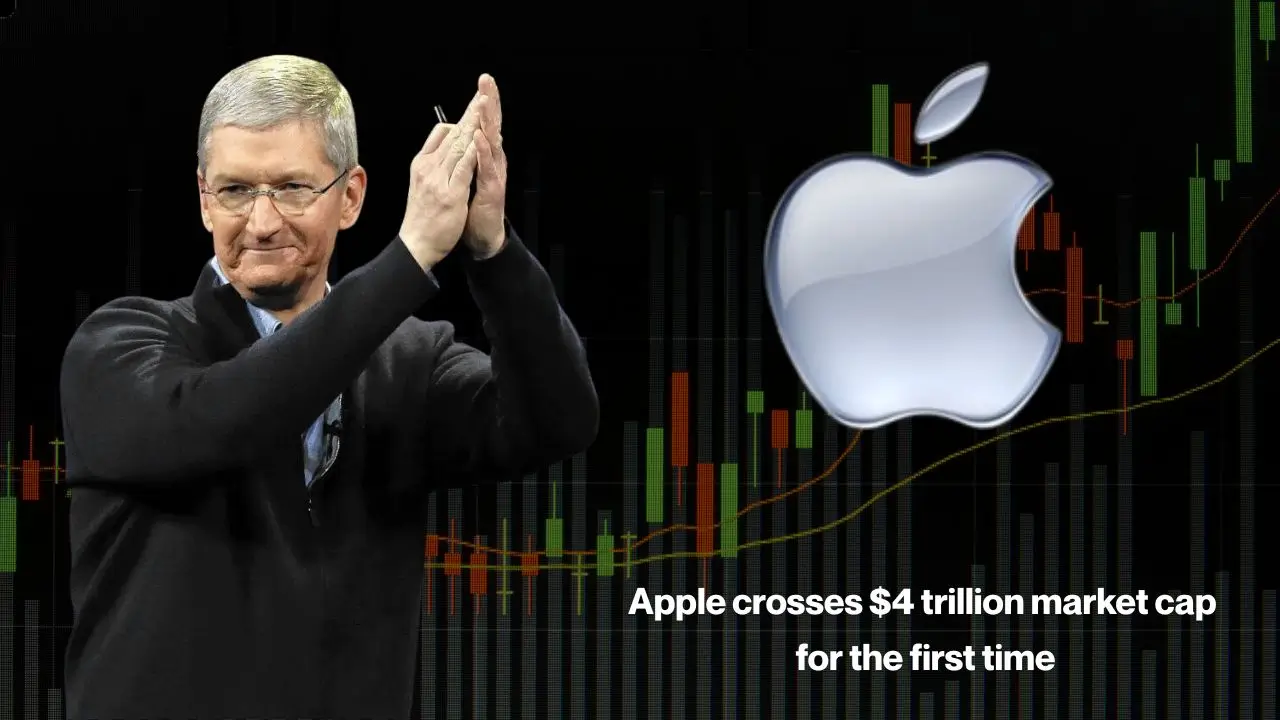
On October 28, 2025, Apple Inc. officially made history by surpassing a $4 trillion market capitalization, becoming the third publicly traded company ever to reach this valuation — following Nvidia and Microsoft.
According to Bloomberg, Apple’s stock rose nearly 2% during early trading, pushing its market cap above the $4 trillion mark before closing slightly below, at $3.99 trillion — a symbolic threshold showcasing the company’s enduring strength and investor confidence.
This achievement comes just months after Microsoft and Nvidia both reached the same milestone, signaling a new phase in the Big Tech race, where artificial intelligence (AI), cloud computing, and high-performance hardware are redefining the global economy.
According to Financial Times, Apple’s iPhone 17 lineup, launched in September 2025, provided a massive boost to revenue. Consumers have praised the model for its upgraded camera system, extended battery life, and deeper AI integration within iOS 19.
Stronger-than-expected demand led many analysts to raise their Q4 earnings forecasts. JPMorgan stated that “Apple is entering the earnings season with the most positive investor sentiment in over a year,” upgrading its target price to $290 per share.
If the iPhone remains Apple’s heart, its Services segment is now the company’s economic engine.
As CNBC reported, Apple’s service revenue — covering App Store, iCloud, Apple Music, and Apple TV+ — is projected to surpass $100 billion annually in fiscal 2025, contributing nearly 30% of total revenue. This high-margin business provides Apple with stable growth even during hardware cycles.
Another critical factor is Apple’s strategic supply chain diversification. The company has been shifting a significant portion of iPhone, iPad, and AirPods production to India and Vietnam — two emerging manufacturing hubs in Asia.
According to JPMorgan analyst Samik Chatterjee, “A combination of increased domestic investment and a rapid shift in production away from China (to India and Vietnam) has significantly strengthened Apple’s position amid trade and tariff uncertainties.”
The same day Apple hit the milestone, Microsoft also maintained its $4 trillion valuation, with shares up over 2%. The rise came after the company finalized its 27% stake in OpenAI, the creator of ChatGPT.
This deepened partnership reinforces Microsoft’s dominance in enterprise AI and positions Azure Cloud as the backbone of global AI infrastructure.
Earlier, in July 2025, Nvidia became the first company to cross the $4 trillion mark, fueled by skyrocketing demand for AI chips. Nvidia’s GPUs have become the “core processors” powering nearly every large-scale AI model worldwide.
With all three giants now valued above $4 trillion, analysts have dubbed them the “Trinity of the AI Era” — representing three pillars of modern tech: hardware (Nvidia), cloud and software (Microsoft), and consumer ecosystems (Apple).
Reaching a $4 trillion valuation is not just about size; it’s a reflection of macroeconomic influence.
According to Reuters, even a 1% move in Apple’s or Microsoft’s stock can shift the S&P 500 index substantially. This underlines Big Tech’s central role in shaping investor sentiment and global capital markets.
Apple’s growing investments in India and Vietnam have turned both countries into strategic manufacturing anchors in the global supply chain.
Factories in Vietnam now assemble a significant portion of AirPods and iPads exported to the U.S., strengthening trade balances and positioning Southeast Asia as a vital production base for high-tech goods.
Despite the milestone, Apple faces several challenges:
AI competition: Compared to Microsoft and Nvidia, Apple is seen as a late mover in large-scale AI. While iOS 19 includes on-device AI features, the company has yet to release its own foundation AI model to rival ChatGPT or Gemini.
Regulatory and policy risks: In both the U.S. and Europe, regulators are tightening scrutiny over Big Tech — from privacy and taxation to antitrust concerns. Such policies could slow Apple’s expansion in digital services.
Innovation pressure: After two decades of iPhone-driven growth, investors are asking: What’s Apple’s next revolutionary product? Projects like Apple Vision Pro and the long-rumored Apple Car remain in experimental phases.
Financial experts note that while Apple and Microsoft sustaining $4 trillion valuations signals strong fundamentals, it also raises valuation concerns.
As CNBC highlighted, “At current P/E levels, both companies need to sustain at least 10–12% annual profit growth to justify their valuations.” Nonetheless, Apple’s expanding services and potential AI roadmap provide long-term upside.
Looking ahead, Apple appears to be redefining its identity — not merely as a hardware company, but as a comprehensive technology ecosystem connecting users, data, and artificial intelligence.
Crossing the $4 trillion mark is not the finish line; it’s the beginning of a new chapter for Apple — one built on AI, digital services, and a restructured global supply chain.
Together with Microsoft and Nvidia, Apple is shaping the future of global technology leadership. Yet, maintaining this position will require relentless innovation — the very spirit that has defined Apple for over two decades.
1. Why is the $4 trillion milestone significant?
It marks Apple’s immense financial strength and market influence, placing it among a select group of global giants that can move entire markets with a single trading session.
2. What fueled Apple’s rise to $4 trillion?
Strong demand for the iPhone 17, rapid growth in services revenue, and a well-diversified supply chain in India and Vietnam were the key drivers behind the company’s valuation surge.
3. Is Apple lagging behind in AI?
Somewhat. Apple has been slower to release large-scale AI products compared to Microsoft or Nvidia. However, its focus on privacy-centric, device-level AI integration could become a major differentiator in 2026.
4. Should investors still consider Apple stock?
Yes, though with measured expectations. Continued innovation in AI and services will be crucial. Investors should watch Apple’s Q4 earnings and its next-generation AI initiatives closely.

.jpg)

.png)
 Tiếng Việt
 English