.png)
 Tiếng Việt
 English


 Asian Stocks Fall Sharply as U.S.–Israel Strikes on Iran Fuel Oil Surge and Risk Aversion
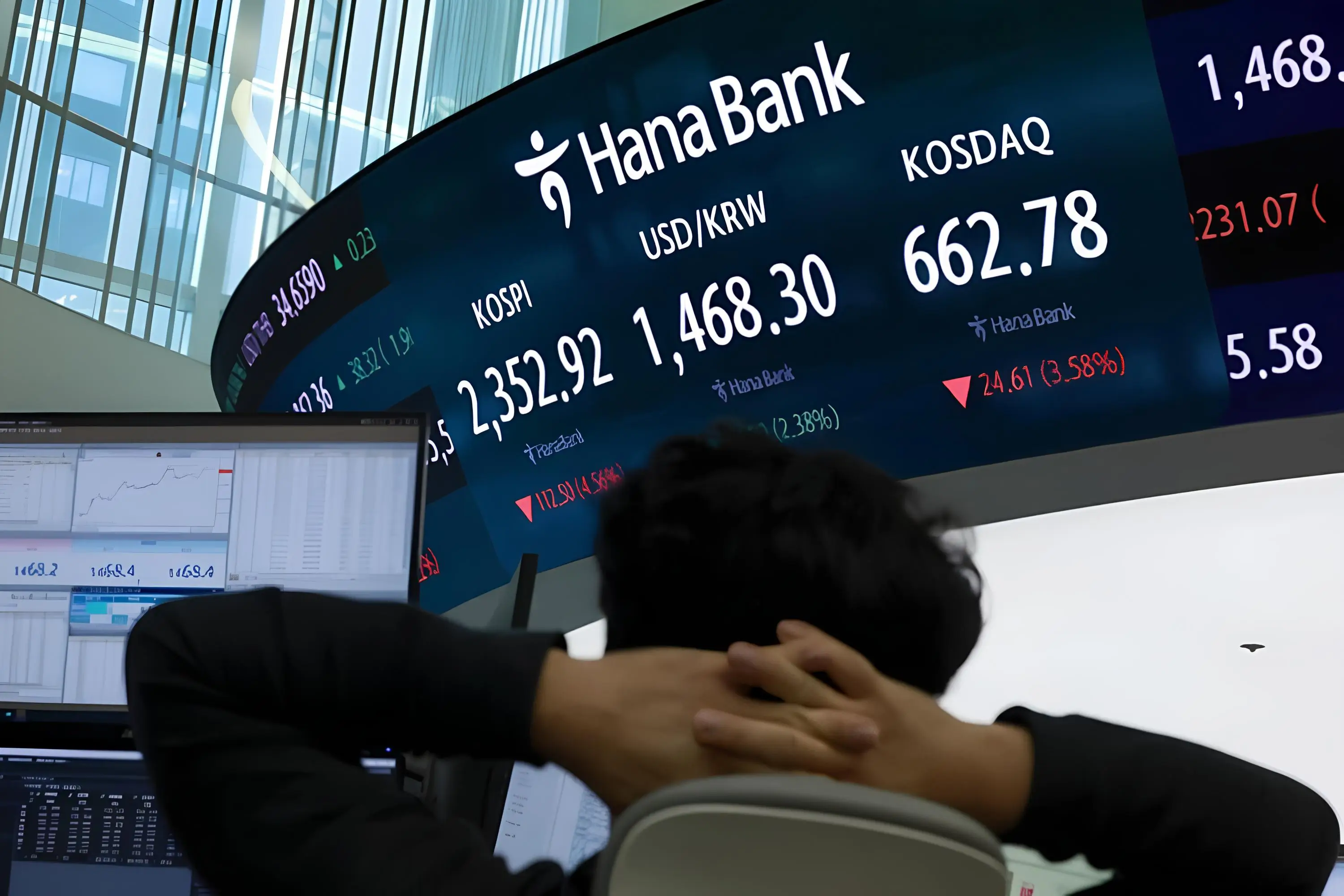
Asian equities retreated broadly on Monday after weekend military strikes by the United States and Israel against Iran rattled global markets, sending oil prices sharply higher and triggering a swift shift away from risk assets.
The escalation in the Middle East compounded an already fragile market backdrop, as investors were grappling with renewed uncertainty over artificial intelligence valuations, stubborn inflation in the United States, and diverging interest rate expectations across major economies.
The result was a synchronized selloff across Asia, with technology stocks leading declines and safe-haven assets drawing renewed demand.
Major benchmarks across Asia opened lower, extending weakness from Wall Street’s Friday session.
Among the hardest hit:
The Hang Seng Index plunged 2.4%, pressured by sharp declines in technology shares.
Japan’s Nikkei 225 fell 1.6%.
The broader TOPIX also dropped 1.6%.
In mainland China:
The CSI 300 slipped 0.6%.
The Shanghai Composite eased 0.5%.
Elsewhere in the region:
Australia’s S&P/ASX 200 lost 0.5%.
Singapore’s Straits Times Index declined 1.8%.
Futures for India’s Nifty 50 were down 0.8%.
The broad-based weakness underscored a clear risk-off tone, as investors reacted to mounting geopolitical instability.
The immediate catalyst for the selloff was a coordinated military offensive by U.S. and Israeli forces targeting Iran over the weekend. The strikes reportedly resulted in hundreds of casualties, including senior Iranian officials and the country’s Supreme Leader.
Tehran responded with retaliatory attacks across parts of the Middle East, including strikes targeting U.S. military bases in the region.
With both Washington and Tel Aviv signaling further military action, and Iran vowing harsh retaliation, markets see little prospect of a near-term de-escalation.
The geopolitical shock triggered a sharp rise in crude oil prices on Monday, as traders priced in potential supply disruptions in a region that accounts for a substantial share of global energy output.
Higher oil prices pose a direct challenge for many Asian economies, which remain heavily dependent on energy imports. A sustained rally in crude could:
Reignite inflationary pressures
Complicate central bank policy decisions
Slow consumer demand
For emerging Asian markets, in particular, rising energy costs could widen trade deficits and strain fiscal balances.
Beyond geopolitics, Asian equities were already facing headwinds from weakness in technology stocks.
Investor enthusiasm around artificial intelligence has cooled in recent weeks, as questions emerge about profitability, competitive dynamics, and long-term monetization.
Software companies have borne the brunt of February’s selloff, amid growing concerns that AI tools may intensify competition and compress margins rather than immediately boost earnings.
The tech-heavy Hang Seng Index, with its large weighting in Chinese internet and semiconductor firms, reflected this pressure most visibly.
In China, investor attention is also turning to the upcoming “Two Sessions” political meetings, scheduled from March 4 to March 11.
These annual gatherings are expected to outline policy priorities for the country’s 15th Five-Year Plan, a critical roadmap as Beijing navigates slowing economic growth throughout the 2020s.
Market participants widely anticipate additional stimulus measures, particularly aimed at supporting domestic demand and stabilizing the property sector.
However, investors remain cautious, seeking clearer signals on:
Fiscal expansion
Industrial policy direction
Support for technology and innovation
Without decisive measures, markets fear growth momentum could remain subdued.
Adding to global uncertainty, stronger-than-expected U.S. producer price data released on Friday renewed concerns about sticky inflation in the world’s largest economy.
Persistent price pressures could prompt the Federal Reserve to keep interest rates elevated for longer than markets had anticipated.
Higher-for-longer U.S. rates typically strengthen the dollar and tighten global liquidity — a challenging combination for Asian equities and emerging markets.
Regional monetary policy expectations remain mixed.
In Japan, weak domestic inflation data have led markets to scale back expectations for further tightening by the Bank of Japan in the near term. The fading prospect of additional rate hikes has added to equity market uncertainty.
Conversely, markets are increasingly confident that the Reserve Bank of Australia may raise rates again in the coming months, as Australia grapples with a resurgence in inflation projected toward late 2025.
This divergence in policy outlook underscores the complex environment facing investors, where geopolitical risk intersects with inflation dynamics and monetary tightening cycles.
As equities retreated, investors shifted toward traditional safe-haven assets, including:
U.S. Treasuries
Gold
The U.S. dollar
Such movements reflect a broader recalibration of risk exposure rather than a localized reaction. When geopolitical shocks coincide with macroeconomic uncertainty, market volatility tends to amplify.
The convergence of geopolitical escalation, rising oil prices, technology sector weakness, and monetary policy uncertainty creates a challenging near-term outlook for Asian equities.
Key factors to monitor include:
The trajectory of Middle East tensions.
Oil price stability and supply chain implications.
Signals from China’s policy meetings.
Upcoming U.S. inflation and labor market data.
If hostilities persist and energy prices remain elevated, inflationary concerns could intensify, further weighing on equities. Conversely, signs of diplomatic de-escalation may provide relief rallies.
Asian markets began the week on a defensive footing, as U.S.–Israel strikes on Iran triggered a sharp rise in oil prices and reignited risk aversion.
While geopolitics provided the immediate catalyst, underlying vulnerabilities — from AI-driven tech corrections to inflation and rate uncertainty — amplified the selloff.
For investors, the current environment demands caution. In a landscape defined by geopolitical shockwaves and macroeconomic crosscurrents, volatility is likely to remain a defining feature of global financial markets in the days ahead.