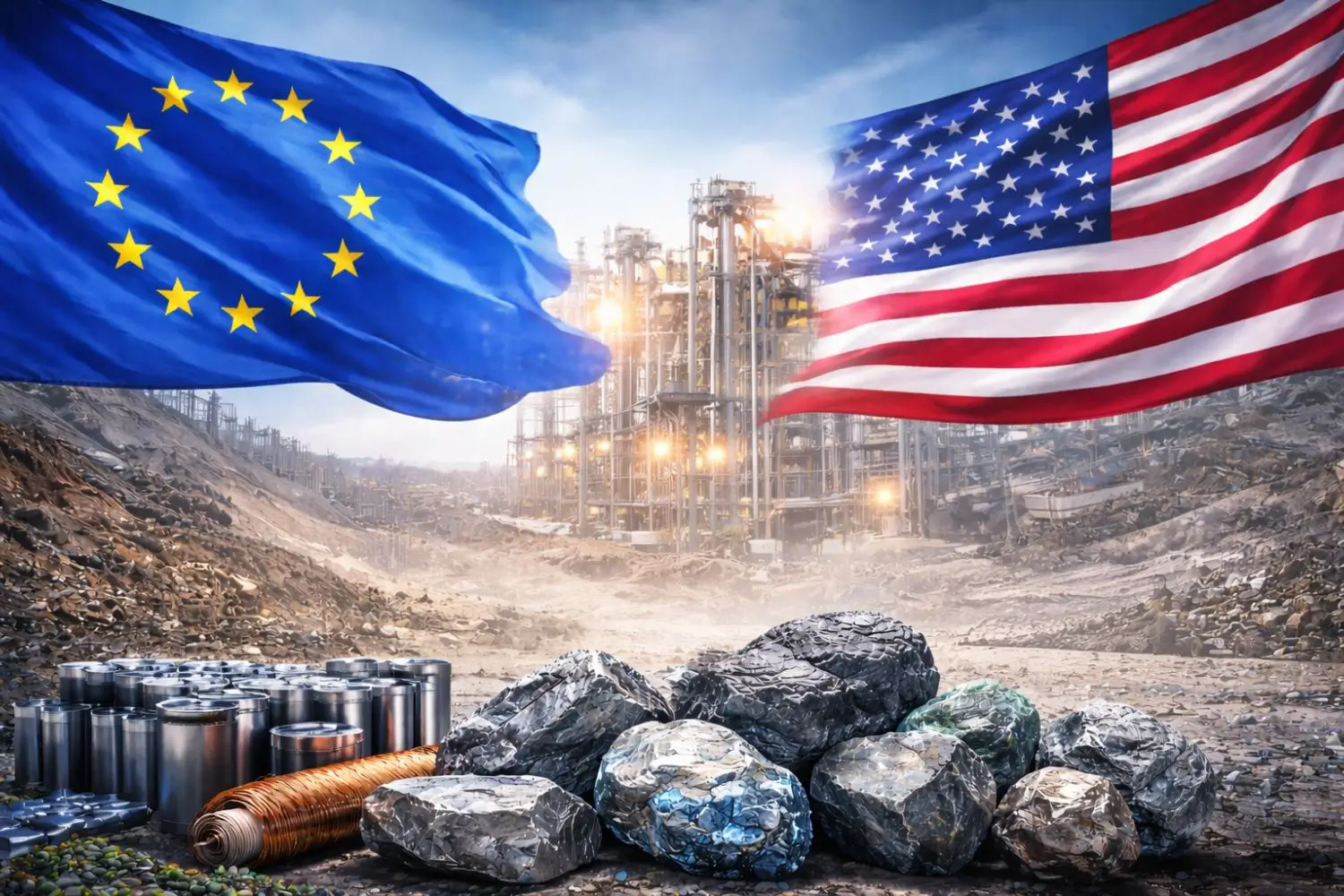
The European Union is preparing to present the United States with a new framework for cooperation on critical minerals, aiming to diversify global supply chains and curb long-standing dependence on China. The initiative comes as Washington and Brussels intensify efforts to secure access to rare earths and other strategic raw materials essential for modern technologies, clean energy, and defense industries.
According to sources familiar with the plan, the EU is ready to sign a memorandum of understanding with the US within the next three months to establish a “Strategic Partnership Roadmap” on critical minerals. The proposal reflects growing concern on both sides of the Atlantic about the geopolitical risks of relying heavily on Chinese supplies.
At present, both the EU and the US depend significantly on China for a wide range of critical minerals, particularly rare earth elements used in electric vehicle batteries, semiconductors, wind turbines, and military equipment. Beijing’s control over extraction and processing gives it considerable leverage in global value chains.
In recent years, China has tightened export rules on several key materials, prompting fears in Western capitals that supply could be weaponized during trade or political disputes. These concerns have pushed critical minerals to the top of the economic security agenda in Washington and Brussels.
The rapid expansion of renewable energy, electric mobility, and digital infrastructure is driving unprecedented demand for lithium, cobalt, nickel, and rare earths. Developing alternative sources, however, requires massive investment, long permitting processes, and coordinated industrial policy—challenges that neither the EU nor the US can easily address alone.
A joint framework is therefore seen as a way to pool financial resources, align standards, and accelerate new mining and refining projects outside China.
The planned memorandum is expected to call for:
Co-development of flagship mining and processing projects in allied countries;
Consideration of price support schemes to shield Western producers from low-cost Chinese competition;
Measures to protect markets from dumping and manipulation;
Creation of a secure transatlantic supply chain from extraction to recycling.
The objective is to gradually reduce exposure to single-country risk while maintaining competitive access to materials vital for high-tech industries.
Notably, the draft reportedly emphasizes the need for both sides to respect each other’s territorial integrity. This clause reflects recent diplomatic tensions after US President Donald Trump signaled interest in Greenland, an autonomous territory of Denmark, an EU member state.
Washington’s urgency stems from China’s 2025 decision to restrict exports of certain rare earths, which rattled global markets. Although those limits were later eased following talks between President Trump and Chinese leader Xi Jinping, US officials remain determined to reduce structural vulnerability.
The US is now promoting a pricing mechanism to support domestic miners and refiners facing competition from subsidized Chinese supply.
On February 2, President Trump launched a $12-billion strategic minerals reserve, aimed at protecting manufacturers against supply shocks. The concept aligns closely with EU ideas for joint stockpiles and emergency response mechanisms.
In the past, Washington encouraged individual EU member states to sign bilateral mineral agreements. The European Commission, however, warned that fragmented deals could weaken the bloc’s bargaining power.
Brussels is therefore urging national governments to allow the Commission to negotiate on behalf of the entire Union, ensuring a coherent transatlantic strategy rather than competing national approaches.
The draft roadmap outlines six main areas:
Supply chain security and development of high-value market segments with crisis response tools.
Industrial and economic integration, including joint investment projects.
Mutual exemptions from export restrictions on critical raw materials.
Research and innovation cooperation across the value chain.
Information sharing and risk assessment, enhanced transparency, and possible joint reserves.
Coordinated positions toward export controls affecting third countries.
If implemented, the partnership could reshape the global minerals landscape:
Diminishing China’s near-monopoly in rare earth processing;
Channeling investment to Canada, Australia, Africa, and Latin America;
Raising short-term costs but strengthening long-term resilience for Western industries.
Experts caution, however, that building alternative supply chains will take years and require close coordination between governments, private investors, and development banks.
The United States is set to host dozens of foreign ministers and senior officials on February 4 to discuss collective action on critical minerals. The European Commission has described these talks as crucial for avoiding dependence on any single supplier, though it has not yet commented publicly on the detailed proposal.
Negotiators on both sides aim to finalize the memorandum within three months, potentially making it one of the most significant economic initiatives between the EU and the US in recent years.
The EU’s proposal for a strategic minerals partnership with the United States marks a decisive shift in transatlantic economic policy. Faced with China’s dominance and the demands of the green and digital transitions, Brussels and Washington are moving toward a coordinated response that blends industrial strategy with geopolitical security.
Whether the plan can translate from paper to mines, refineries, and factories remains uncertain. Yet the direction is clear: critical minerals are becoming the new frontier of global power, and the EU and US intend to compete together rather than alone.

.jpg)

.png)
 Tiếng Việt
 English