.png)
 Tiếng Việt
 English


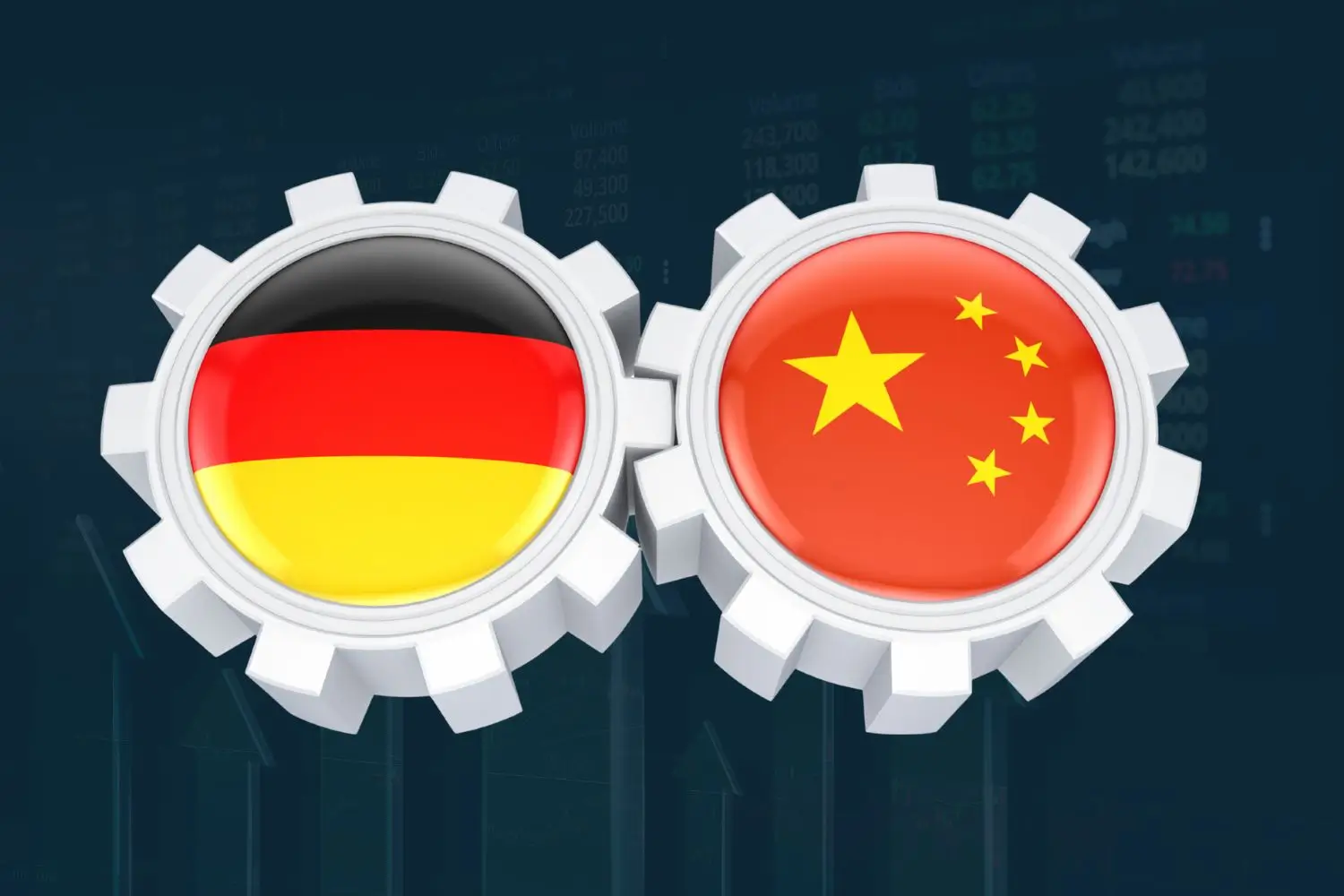 China has overtaken the United States to become Germany’s largest trading partner in 2025, according to new data released on February 20 by the Federal Statistical Office of Germany.
The figures underscore the depth of economic ties between Europe’s largest economy and China, while also revealing mounting structural imbalances. Germany’s trade deficit with China widened to a record €89.3 billion, highlighting growing dependency concerns amid broader geopolitical and economic headwinds.
The shift marks a significant development in global trade patterns at a time when Germany is grappling with weak growth, elevated energy costs, and lingering aftershocks from successive global crises.
China had already been Germany’s largest supplier of goods since 2015, reflecting a long-standing industrial and supply chain integration between the two export-driven economies.
Although the United States briefly surpassed China in 2024, Beijing reclaimed the top position in 2025. Chinese exports to Germany rose 8.8% year-on-year, pushing total bilateral trade volume to €251.8 billion.
In contrast, German exports to China declined sharply by 9.7% over the same period. The value of Chinese goods entering Germany more than doubled the value of German products shipped to China.
The widening deficit reflects Germany’s heavy reliance on Chinese intermediate goods, electronics, machinery components, and consumer products. At the same time, weakening Chinese domestic demand and intensifying global competition have constrained German exports, particularly in the automotive and industrial machinery sectors.
The record €89.3 billion trade gap raises fresh questions about Germany’s long-term economic strategy and its exposure to external shocks.
While China rose to the top spot, the United States remains Germany’s most important export destination.
However, German exports to the U.S. fell 9.4% in 2025. As a result, Germany’s trade surplus with the United States shrank from €69.6 billion to €51.9 billion.
The contraction reflects softer U.S. demand, currency fluctuations, and the impact of evolving trade policies. For Germany, which depends heavily on exports to sustain growth, declining shipments to both China and the United States signal mounting external pressure.
On a broader scale, Germany’s total exports rose by less than 1% in 2025, while imports climbed 4.3%. Despite the divergence, the country maintained a substantial overall trade surplus of €200.5 billion.
The figures demonstrate Germany’s continued export strength but also reveal slowing momentum in global demand.
Germany’s economic model, long built on high-value manufacturing exports, is facing multiple stress points:
Slower global growth
Trade fragmentation
Geopolitical tensions
Elevated production costs
These structural challenges are increasingly visible in the country’s external trade data.
Germany’s economic headwinds intensified following the outbreak of the Ukraine conflict in 2022. Prior to the crisis, Germany sourced up to 55% of its natural gas from Russia, creating significant vulnerability when supplies were disrupted.
The resulting surge in energy prices has had lasting consequences for industry, particularly energy-intensive sectors such as chemicals, metals, and manufacturing.
In mid-January 2026, the German Chamber of Commerce and Industry warned that persistently high energy costs were contributing to a worrying rise in corporate insolvencies.
The pressure on small and medium-sized enterprises has been particularly acute, as they struggle to absorb higher operational expenses while facing weakening demand abroad.
Adding to the bleak outlook, the German Economic Institute estimated in early February 2026 that successive shocks — including the COVID-19 pandemic and the Ukraine conflict — have cost Germany more than $1 trillion in lost GDP.
The cumulative impact reflects:
Disrupted supply chains
Inflationary energy shocks
Reduced export competitiveness
Investment hesitation
Together, these factors have eroded Germany’s growth trajectory and weakened its position as Europe’s industrial engine.
China’s renewed position as Germany’s largest trading partner presents both opportunity and risk.
On one hand, strong trade flows reinforce economic interdependence and offer market access for German firms. On the other, the widening deficit amplifies concerns about strategic dependence on Chinese manufacturing and critical supply chains.
The European Union has increasingly emphasized “de-risking” rather than full decoupling from China. For Germany — whose industrial base is deeply integrated with Chinese supply networks — recalibrating this relationship will require delicate balancing.
Looking ahead, Germany faces several pressing priorities:
Reducing energy costs to restore industrial competitiveness
Diversifying trade partnerships to mitigate geopolitical risk
Strengthening domestic investment and innovation
Addressing structural imbalances in trade flows
While Germany’s overall trade surplus remains substantial, the composition of that surplus is shifting in ways that expose vulnerabilities.
If export growth continues to stagnate and import reliance deepens, Berlin may face increasing pressure to adapt its economic strategy.
China’s return as Germany’s largest trading partner in 2025 marks a pivotal moment in Europe’s trade landscape. With bilateral trade reaching €251.8 billion and Germany’s deficit with China hitting a record €89.3 billion, the data highlight both economic interdependence and structural imbalance.
At the same time, shrinking exports to the United States and ongoing energy-related challenges underscore the fragility of Germany’s export-driven model.
As Europe’s largest economy navigates geopolitical tension, energy transition, and global trade realignment, the evolving Germany–China relationship will remain central to its economic future.