Tesla plans to phase out all China-made components from its U.S.-manufactured cars within two years as geopolitical tensions push global companies to redraw supply chains.
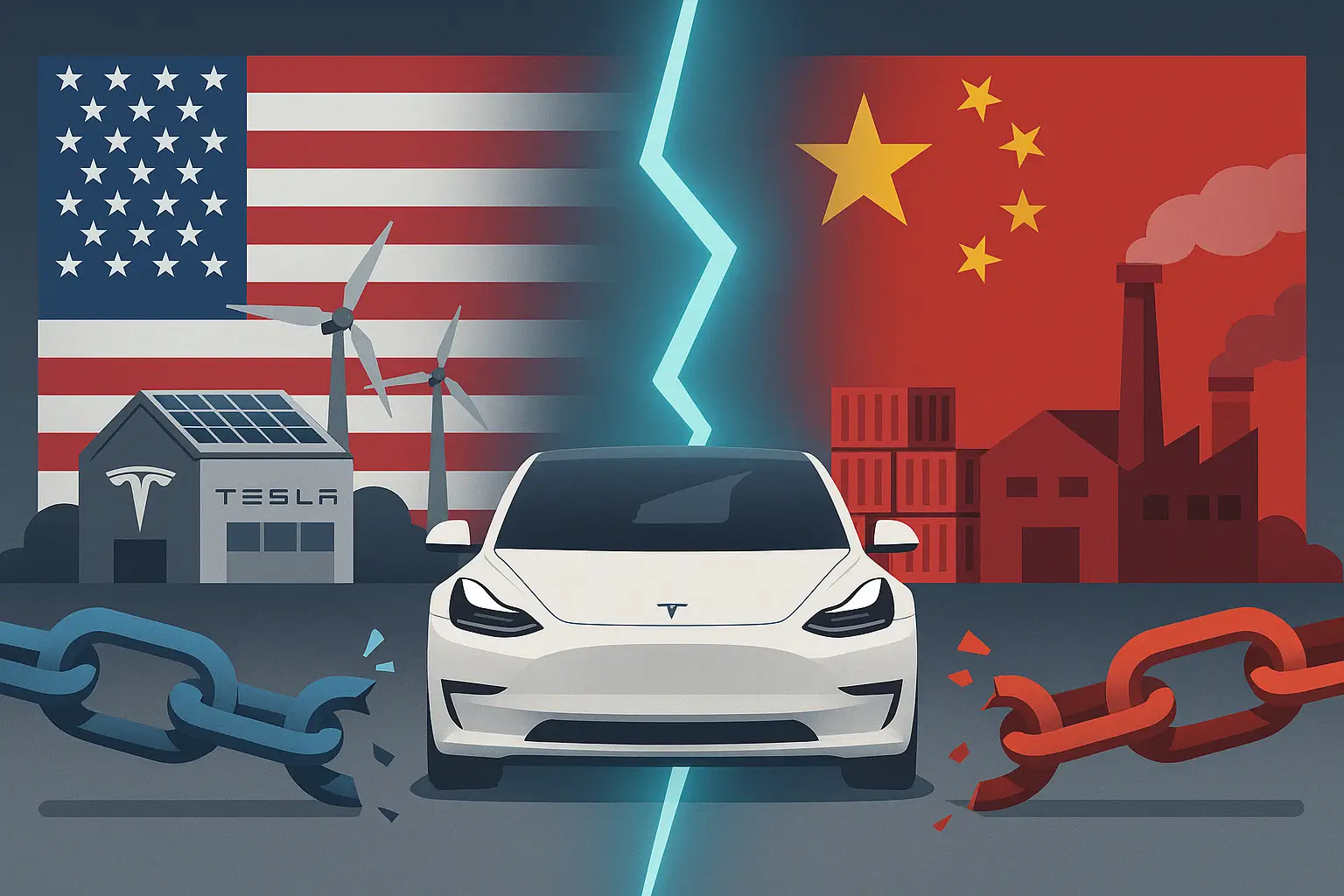
Tesla Inc. is pushing to eliminate all China-made components from its vehicles built in the United States within the next one to two years, according to people familiar with the matter.
The company has already instructed key suppliers to exclude China-sourced parts from its U.S. manufacturing operations, marking a decisive step in its long-term effort to reduce exposure to Beijing amid intensifying geopolitical tensions.
Sources said Tesla began phasing out Chinese suppliers earlier this year and has already replaced several China-made parts with alternatives produced elsewhere. The move reflects the growing reality that U.S. manufacturers are being forced to restructure their supply chains to navigate rising tariffs and political risk between Washington and Beijing.
The decision underscores how deepening U.S.–China tensions are reshaping global trade and technology supply routes.
Tesla’s pivot follows President Donald Trump’s renewed tariff measures on Chinese imports, which have accelerated the broader trend of U.S. firms decoupling from Chinese manufacturing networks.
“Tesla’s decision is not purely commercial; it’s strategic,” said a senior industry analyst in Tokyo. “Companies are now redesigning supply chains not just for efficiency, but for resilience and compliance.”
China has long been a dominant producer and exporter of automotive components, including chips, batteries, and metal frames. These parts are often cheaper due to large-scale manufacturing capacity, lower labor costs, and a weaker yuan, making China an integral part of global automotive supply networks.
However, recent political and regulatory developments have prompted multinational firms to shift production to Mexico, Vietnam, and Southeast Asia to mitigate risk.
In recent years, Tesla has quietly worked with several Chinese partners — including seat casing and metal housing manufacturers — to establish new factories and warehouses in Mexico and Southeast Asia.
These efforts were initially aimed at reducing logistics bottlenecks caused by the COVID-19 pandemic, which severely disrupted the global flow of goods in 2020–2022.
Now, those moves have become part of a broader strategic pivot.
“The pandemic was the trigger; tariffs were the accelerator,” said one supply chain executive familiar with Tesla’s operations.
The automaker’s U.S. market remains its largest globally, and its Shanghai Gigafactory continues to serve as Tesla’s key export hub for Asia and Europe. However, the company now wants to ensure that all vehicles built for the American market use non-Chinese components, particularly as new trade restrictions and national security reviews tighten around electric vehicles (EVs).
The renewed wave of tariffs introduced by the Trump administration this year has fast-tracked Tesla’s diversification plan. The U.S. imposed stricter duties on a wide range of Chinese goods, including automotive components, in an effort to reduce strategic dependence and pressure Beijing on trade negotiations.
Washington’s latest measures also reflect growing bipartisan concern about China’s role in critical technologies, from EV batteries to semiconductors.
In response, Tesla and other automakers are seeking alternative sourcing options in regions such as Mexico, Thailand, and Indonesia, which offer lower manufacturing costs and access to trade agreements with the U.S.
“Tesla’s transition away from Chinese parts is part of a much larger trend among U.S. industrial companies,” noted a Bloomberg Intelligence report. “It mirrors the tech sector’s move to reduce exposure to Chinese manufacturing, even if it raises costs in the short term.”
Meanwhile, China’s domestic technology and automotive firms have also begun phasing out U.S. components — a form of reverse decoupling that further entrenches the economic divide between the world’s two largest economies.
Tesla’s shift is emblematic of a larger realignment in global supply chains, as manufacturers strive to balance cost efficiency with geopolitical resilience.
Analysts say this transformation could redefine global trade patterns over the next decade, with Mexico and Southeast Asia emerging as key production hubs for both Western and Asian multinationals.
While Tesla continues to depend heavily on China for its Shanghai operations, the company’s latest U.S. strategy highlights how automakers are preparing for a future where trade friction becomes the norm rather than the exception.
“Tesla’s move symbolizes a broader industrial decoupling between the U.S. and China,” said a trade expert at Oxford Economics. “The global auto industry will need to adapt quickly or risk being caught between two competing ecosystems.”
Despite potential cost increases, Tesla is betting that supply chain diversification will ultimately strengthen its long-term competitiveness, especially as governments worldwide link EV manufacturing incentives to domestic or allied-country sourcing requirements.
Tesla’s decision to remove Chinese-made components from its U.S. production marks a strategic milestone in the ongoing U.S.–China economic decoupling.
While it underscores Washington’s toughening stance on trade, it also highlights the growing complexity — and cost — of building truly global manufacturing networks in an era of political fragmentation.
As automakers and tech firms follow Tesla’s lead, the next few years could witness a fundamental reshaping of supply chains, with regional alliances replacing global integration as the new model for industrial resilience.
1. Why is Tesla removing Chinese components from U.S. production?
→ To reduce reliance on China amid rising tariffs, political tensions, and national security concerns related to electric vehicle supply chains.
2. How long will Tesla’s transition take?
→ The company aims to complete the shift within one to two years, gradually replacing Chinese-made components with parts from Mexico and Southeast Asia.
3. Will this affect Tesla’s operations in China?
→ No. Tesla’s Shanghai Gigafactory will continue to operate for Asian and European markets using local components. The change applies mainly to vehicles made in the U.S.
4. What does this mean for the global auto industry?
→ It signals a broader “de-Chinafication” trend, as multinational automakers rebuild supply chains to align with shifting trade and security policies.

.jpg)

.png)
 Tiếng Việt
 English