.png)
 Tiếng Việt
 English


As gold prices hit new records, China is quietly stockpiling massive quantities of the precious metal — far beyond official figures — as part of a de-dollarization strategy that’s reshaping global markets.
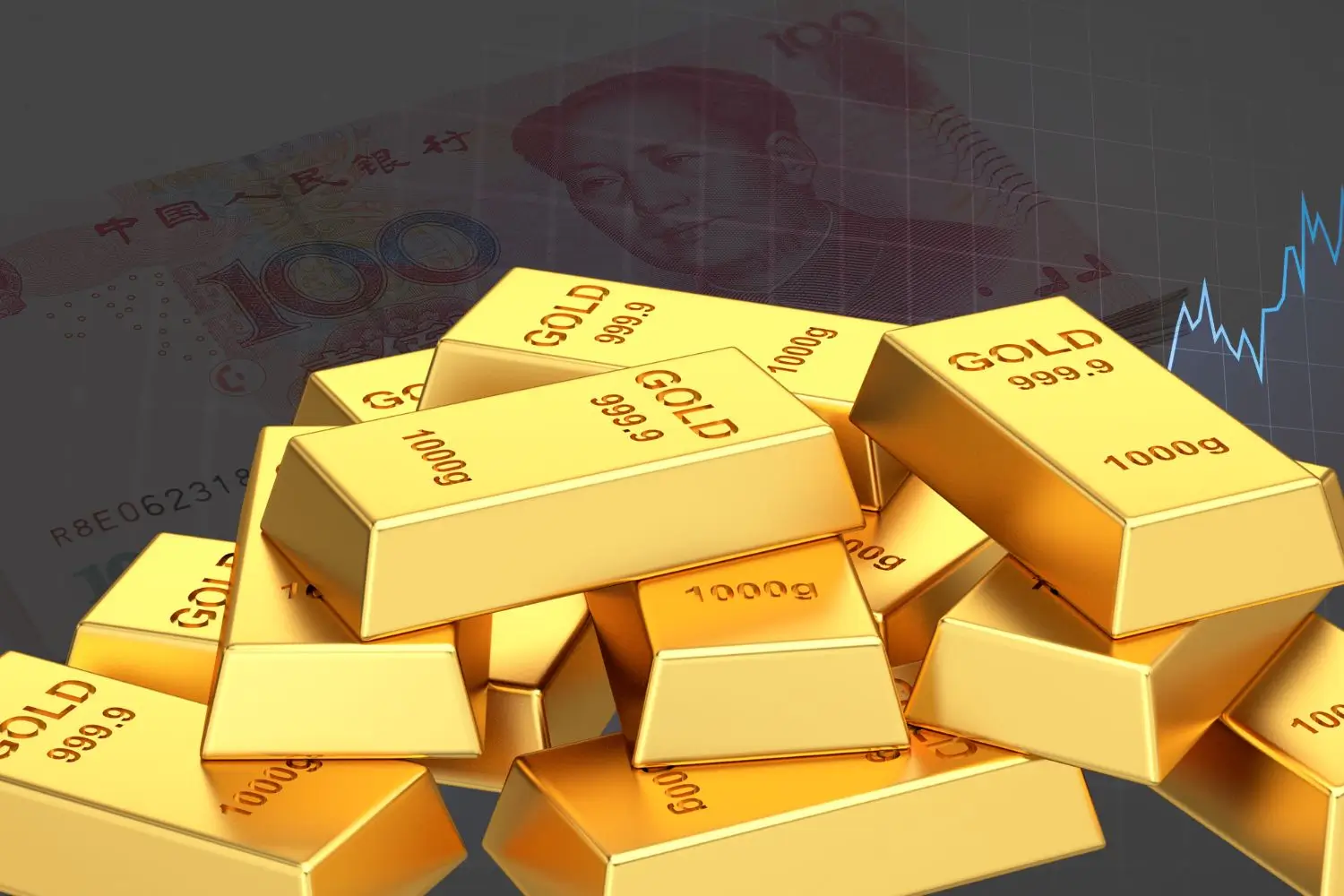
As gold prices soar to unprecedented highs, traders and economists alike are asking the same question: Who’s buying — and why now?
According to leading analysts, the answer lies in China, where an unreported surge in gold purchases is quietly altering the global supply landscape and fueling a historic rally.
The world’s second-largest economy appears to be buying far more gold than its official disclosures suggest, in what many believe is part of a long-term plan to diversify reserves and reduce dependence on the U.S. dollar.
The People’s Bank of China (PBoC) reports modest gold purchases — just 1.9 tons in August, 1.9 tons in July, and 2.2 tons in June — but few market participants take those numbers at face value.
Analysts at Société Générale estimate that China’s total gold purchases could reach 250 tons in 2025, accounting for over one-third of all central bank demand worldwide.
“China is buying gold as part of its de-dollarization strategy,” said Jeff Currie, Head of Commodities Strategy at Carlyle.
“Unlike oil, which can be tracked by satellite, gold movements are opaque. There’s simply no way to know where it’s going or who’s buying.”
Beijing’s gold accumulation is a key pillar of its broader effort to reduce reliance on the U.S. dollar in global trade.
Alongside pushing for yuan-based settlements, China is steadily shifting its reserves toward hard assets like gold — an enduring hedge against sanctions, inflation, and financial dominance by the West.
Gold provides two major strategic advantages for China:
Sovereign control over reserves, independent of the SWIFT system.
Credibility for the yuan, positioning it as a potential alternative reserve currency backed by tangible value.
Bruce Ikemizu, Managing Director of the Japan Bullion Market Association, believes China’s true reserves could be around 5,000 tons — roughly double the official number.
“People no longer fully trust the official data — especially when it comes to China’s gold reserves,” Ikemizu said.
China isn’t alone in keeping quiet.
According to the World Gold Council (WGC), only one-third of central bank gold purchases are now reported to the International Monetary Fund (IMF), down from nearly 90% just four years ago.
Over the past decade, gold’s share of global reserves (excluding the U.S.) has climbed from 10% to 26%, making it the world’s second-largest reserve asset after the dollar.
“Discretion is political,” explained Nicky Shiels, Head of Metals Strategy at MKS Pamp in Switzerland.
“Revealing gold purchases can attract unwanted attention from Washington. For many emerging economies, secrecy is the safest policy.”
Insiders say China’s gold accumulation is managed by the State Administration of Foreign Exchange (SAFE), under a structured one-year and five-year acquisition plan.
But SAFE is not the only actor — entities such as the China Investment Corporation (CIC) and even the People’s Liberation Army (PLA) are reportedly involved, none of which are required to publish holdings.
Analysts use alternative methods to gauge China’s true appetite for gold.
One indicator is UK gold exports to China, as most large “good delivery” 400-ounce bars used by central banks are refined and traded through London. Société Générale estimates that China imported around 250 tons of gold this year alone.
A separate study by Plenum Research (Beijing) found a “gold gap” — the difference between imports, domestic production, and reported reserves — of 1,351 tons in 2023 and 1,382 tons in 2022, six times higher than official figures.
China’s ambitions extend beyond accumulation.
It is also positioning itself as Asia’s emerging hub for gold storage and settlement.
Recently, Cambodia agreed to store its newly acquired gold — purchased in yuan — at the Shanghai Gold Exchange vault in Shenzhen, signaling Beijing’s intent to redefine the global gold ecosystem.
This aligns with China’s broader strategy: to elevate the yuan’s global standing and gradually erode the U.S. dollar’s monopoly on reserve and trade finance.
The opacity surrounding central bank buying has created an unprecedented challenge for traders.
As official transparency declines, analysts increasingly rely on alternative data — such as transport routes, refiner output, and serial tracking of bullion bars — to estimate real demand.
Despite a strong dollar, gold prices have surged past $4,300 per ounce, an extraordinary signal that geopolitical demand is outweighing traditional market logic.
“The gold market is unique — and complex,” said Michael Haigh, senior strategist at Société Générale.
“Without clear insight into central bank flows, predicting direction becomes nearly impossible.”
Adrian Ash, Director of Research at BullionVault, added:
“No one really knows how much gold China holds. The truth is buried under layers of secrecy — a mystery wrapped in an enigma.”
For much of the past decade, global finance has been defined by debt, liquidity, and digital assets.
Now, amid mounting political risks and declining trust in fiat systems, gold is reclaiming its historical role as the ultimate store of value.
China’s silent accumulation signals more than a national strategy — it may mark the beginning of a systemic shift away from dollar hegemony.
If this trend continues, analysts warn, gold could enter a new “super cycle” where price ceilings become increasingly irrelevant.
In short, the world’s oldest currency — gold — is quietly regaining its throne.
1️⃣ Why is China secretly buying gold instead of disclosing it?
→ To avoid political tension and market disruption while strategically diversifying away from the U.S. dollar.
2️⃣ How much gold does China actually hold?
→ Analysts estimate around 5,000 tons, nearly double the official figure published by the PBoC.
3️⃣ How does this affect global gold prices?
→ Massive, unreported demand has made gold prices more volatile — and persistently higher than fundamentals suggest.
4️⃣ What is China’s ultimate goal?
→ To de-dollarize its reserves, strengthen the yuan’s credibility, and build financial sovereignty insulated from Western influence.