.png)
 Tiếng Việt
 English


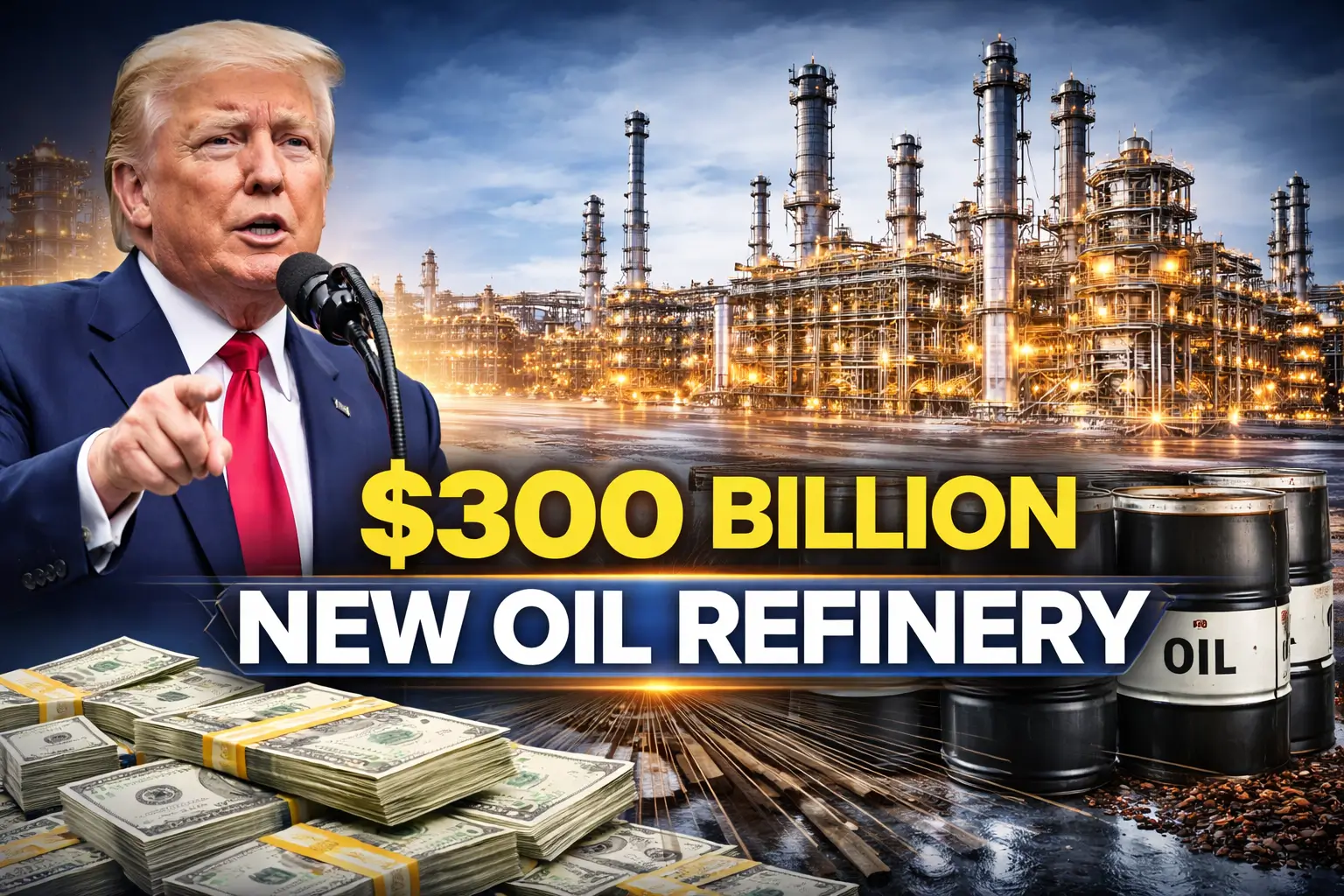 The United States could soon see the construction of its first new oil refinery in more than 50 years, marking a significant milestone for the country’s energy sector. The project is expected to be backed by a massive investment from Reliance Industries, India’s largest private energy conglomerate controlled by billionaire Mukesh Ambani.
The announcement was made by U.S. President Donald Trump on March 11, revealing plans to build the refinery at the Port of Brownsville in Texas. The project is expected to strengthen U.S. energy security, boost domestic shale oil production, and generate billions of dollars in economic impact.
According to Trump, the initiative is part of a “historic $300 billion deal — the largest in U.S. history.” He also thanked Reliance Industries for its large-scale investment and confidence in the American energy sector.
Reliance Industries is widely regarded as one of the world’s most influential energy and industrial conglomerates. The company operates the Jamnagar refinery complex in India, which is currently the largest oil refining hub in the world.
According to global financial market data, Reliance has a market capitalization of roughly $206 billion, underscoring its strong financial position and global reach in the energy industry.
The company’s involvement in the U.S. refinery project is seen as a strategic move to expand its international footprint while capitalizing on the abundant shale oil resources available in the United States — one of the largest energy markets globally.
However, as of now, neither Reliance Industries nor the project developer America First Refining has issued an official comment regarding the details of the investment.
President Trump stated that the new Texas refinery is expected to become the “cleanest oil refinery in the world.”
The facility will be specifically designed to process 100% American shale oil, particularly light crude extracted from major production regions such as the Permian Basin.
Light shale oil offers advantages such as relatively lower extraction costs and abundant supply. However, many existing U.S. refineries were originally designed decades ago to process heavier imported crude oil, limiting their ability to fully utilize domestic shale resources.
The new refinery in Texas aims to address this challenge by incorporating advanced refining technologies that improve efficiency while reducing environmental emissions.
Beyond technological improvements, the project is also expected to deliver significant economic benefits to the Texas region, including thousands of construction jobs and increased activity in logistics and energy trade.
According to a statement from America First Refining, the refinery project is tied to a 20-year energy supply agreement with a global energy company.
The agreement covers the purchase, processing, and distribution of shale oil produced in the United States, establishing a long-term domestic energy supply chain.
Although the identity of the investor was not officially disclosed, the company confirmed it had secured a “nine-figure investment” with a “ten-figure valuation,” indicating a substantial financial commitment.
Under the project plan, the refinery is expected to process approximately 1.2 billion barrels of U.S. light shale oil, with an estimated value of around $125 billion.
After refining, the facility is projected to produce about 50 billion gallons of refined products, including gasoline, diesel, and petrochemical feedstocks, with a combined value estimated at $175 billion.
According to Trey Griggs, President of America First Refining, the U.S. energy sector currently faces an unusual imbalance: an abundant supply of light shale oil but insufficient refinery capacity designed to process it efficiently.
Over the past five decades, the United States has built very few new large-scale refineries. Most existing facilities were designed many years ago to process heavy crude oil imported from regions such as the Middle East or Latin America.
As a result, the country has not been able to fully maximize the value of its rapidly growing shale oil production.
The new refinery project in Texas is expected to strengthen the domestic energy supply chain and provide an important outlet for America’s expanding shale oil resources.
The refinery project was announced at a time when global oil markets are experiencing heightened volatility.
Geopolitical tensions in the Middle East — particularly the conflict involving the United States, Israel, and Iran — have pushed oil prices higher in recent weeks.
At one point earlier this week, crude oil prices approached $120 per barrel, raising concerns about rising global energy costs and inflation.
As of 10:38 p.m. Eastern Time, U.S. West Texas Intermediate (WTI) crude was up 1.15% at $84.71 per barrel, while Brent crude, the global benchmark, rose 1.33% to $88.98 per barrel.
Against this backdrop, expanding domestic refining capacity is viewed as a strategic move to enhance U.S. energy independence and resilience.
If completed as planned, the new refinery in Texas could become one of the largest energy infrastructure projects in the United States in decades.
Beyond improving the utilization of domestic shale oil, the refinery could also increase the supply of refined petroleum products for global markets, particularly in Europe and Asia.
Furthermore, the participation of a major Asian energy conglomerate in a large-scale U.S. refinery project highlights the increasing globalization of energy supply chains, as companies seek opportunities in resource-rich markets.
In the long term, the project could further strengthen the United States’ position as one of the world’s leading energy producers, while supporting economic growth in an increasingly competitive global energy landscape.